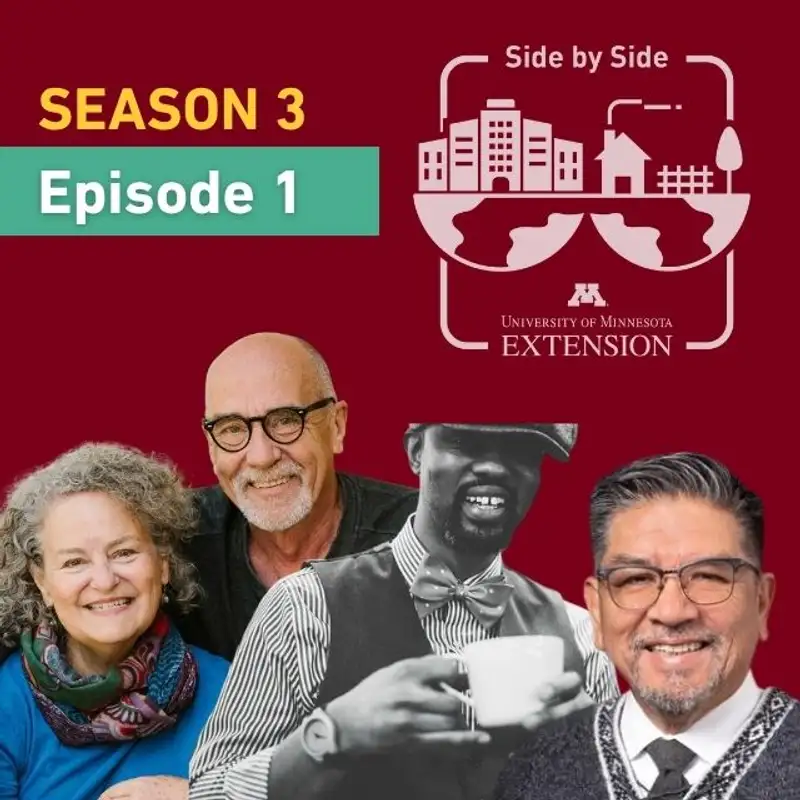
Houston White, Pablo Obregon, and Emily & Glenn Swanson share what North Minneapolis, Willmar, and Carlton County can teach us about the power of "place knowing"
We ain't got a barrel of money. Maybe we're ragged and funny, but we'll travel along singing a song side by side.
Emily Swanson:Looking for what's working takes you always to culture. And in our world up here, creative achievement needs to include all the people working on food sovereignty and sustainable regenerative agriculture, as well as the people who are painting or sculpting or playing instruments or involved in various creative businesses. And so the emphasis on locally homegrown, homemade has been the big push here.
Houston White:For me, it has to get back to the reality of connecting the truths of the rural experience to the reality of urban America. Right? How can you connect a small group of people in the black community, specifically the church, the barbershop, and grandma's house are the three most trusted institutions. And so going back to this idea of small roots to build big ideas that actually sustain the the standard for place making in urban America because that is what we don't have right now.
Pablo Obregon:I believe that part of my role as a human being is to connect people, connect ideas, connect values. It takes a lot of dedication. It takes a lot of sweat and tears sometimes, but whatever expression of art that we may be offering or talking about, I think that is a silent piece of a voice crying out saying we are more alike than we are unlike.
Ellen Wolter:That's Emily Swanson, owner of the Oldenburg House in Carlton County, Minnesota. Houston White, founder of Houston White Ventures and McSteap Strategy, which focuses its efforts in Camden Town and North Minneapolis, and Pablo Obregon, director of community growth for the city of Wilmer, Minnesota. They joined me along with Emily's husband, Glenn, to share their experiences as placemakers and builders who work to develop and revitalize their communities. They describe the different community development systems they experience in rural, urban, and small town places and bond over the values of shared humanity, locally grown goods, and arts and culture as strengths that are essential to effective community development strategies. Houston, who authored the book Culture Making, describes being a serial social entrepreneur who reinvests into the community that raised him.
Ellen Wolter:Pablo shares his journey from Lima, Peru to Wilmer and his focus on building broad based coalitions as Wilmer has experienced rapid demographic change and immigrant contributions to economic growth. Glenn and Emily explain what it's like to run a bed and breakfast in Carlton County using music, arts, and place knowing to strengthen their community. And together, they challenge flattened narratives about their communities, discuss systemic divides like uneven philanthropy across geography, and highlight the ways in which their community building efforts connect people through the strength of local culture. And an important thread in this conversation is music, so check out the show notes for a playlist with recommendations from each of our guests from this week.
Glenn Swanson:When they've all had their quarrels and party, we'll be the same as we started just to travel along singing a song side by side.
Ellen Wolter:This is Ellen Walter, and welcome to the Side by Side podcast.
Ellen Wolter:Well, welcome, everyone. It is such a pleasure to have you on today. And, Houston, I'm gonna start with you. Can you just briefly introduce yourself and share a little bit about your work and your community?
Houston White:Yeah. Well, first, thank you for having me. I'm super excited for this conversation. My name is Houston White. I am a Northside kid.
Houston White:I grew up between three places, North Minneapolis, Jackson, Mississippi, and Hayward, Wisconsin, believe it or not. And what I found was there was a through line. That's why this conversation was so intriguing to me because bridging the gaps between the inner city and rural America. I am that kid that grew up in all those places. It's a very diverse group of of folks who raised me.
Houston White:And the the commonality was always the soul matter. Right? Like, legacy. Like, what are we after? And when I was young, you know, I had this idea I was gonna be this really successful entrepreneur, I was gonna make a lot of money.
Houston White:And then as I got a bit older, I realized what difference does it make if you make a bunch of money and the village that raised you. And the truth of who you are wasn't really connected to your work. And so that's where my work in Camden Town kind of began. As a kid from North Minneapolis, one of the things I realized is so much of what I benefited from. I was the benefactor of of entrepreneurship, of folks with certain values that they passed to me.
Houston White:And we were always struggling in North Minneapolis with just kinda giving donations or people who were had made it leaving. And so my work kind of shifted to everything I did as an entrepreneur, I was going to try to find a way to pour back the benefit of those businesses or whatever I did back into that community that helped to create me. And literally try try to be a bit of the change that I wanted to see as opposed to talk about it and or just escape and give money. So that is my work in a nutshell. That's why I call myself a social serial entrepreneur because there's a social impact connected to all of it.
Houston White:And it just is rooted in my purpose and how I grew up.
Ellen Wolter:Thanks, Houston. Pablo, what about you?
Pablo Obregon:The home is a little far away, Lima, Peru. I came via Los Angeles, California, and then went to Luther Seminary in Saint Paul, Minnesota. And from there, I moved to Wilmer in 1992. So it's been a great journey. I'm just afraid where my next move will be because it seems like every place I go is shrinking in population wherever I go.
Pablo Obregon:The experience that I have also is very similar to Houston. Growing up in Lima with eleven, twelve million people in in the city, Now having this experience in rural Minnesota, a town of 21,000 plus, I have learned to appreciate both realities, and I think the appreciation comes where I can find a common ground in both of them. That's something that I can be, especially the humanness of it. It feels like that's where my passion for community growth comes from. I'm gonna share here a short story my daughter helped me out with about where does my passion come for this work.
Pablo Obregon:My daughter, I was driving her to school, and she asked me, daddy, where are you from? And I say, I'm from Lima, Peru. And then my daughter, again, second question was, what about mommy? Where is she from? I said she was born in London, England.
Pablo Obregon:A few moments later, asked again, what about my bro? Where is my brother from? I said, well, he was born in Minneapolis. And and she asked again, what about me? She said.
Pablo Obregon:And I said, well, you are ordering San Jose, Costa Rica. Once we parked in the car, she jumped over the seat and started to shake my arm saying, daddy, daddy, isn't that amazing how we are now together in one family? Which to me, it means she saw the world with no barriers, no boundaries, yet we are now together in in one community. So I guess for all of us as we are listening to this podcast, your community is supposed to be who you have around. It doesn't matter where we all come from.
Pablo Obregon:That is the beginning of my passion for community work. The main part of my work is to establish networks and try to cooperate or help people in the different systems find common ground so that we can continue to serve the community in ways that probably in the past were done as silos, and creating partnerships is one of my main goals.
Ellen Wolter:Glenn and Emily, what about you? Can you share a little bit about your work and where you live? Where is home for you?
Emily Swanson:Well, I'll start. I love the fact that we've talked a little bit about where we came from, and you made me think about my grandfather and the fact that my earliest memories have always been around the idea of service to your community is the rent you pay for the space you occupy. We've just had that drilled into us by his way of working. And then another phrase that I learned somewhere early on in my work in community development was the word development is really de envelop. And the idea of it is that you are taking the envelope off the love letter that the community is trying to send to all of its people to say we all belong.
Emily Swanson:We are all part of this. And and that's really what our work has been up here in Carlton County and the Fond Du Lac Reservation. We're in the most beautiful place. We're looking out at 2,000,000,000 year old rock. And the St.
Emily Swanson:Louis River comes right through this area. For the Native American people, the Anishinaabe who are settled here now and have been for about eight thousand years, this is considered the beating heart of North America, the beating heart of Turtle Island. So we run a bed and breakfast and an event venue. And we do a lot of community development work around the edges of all of that.
Ellen Wolter:Glenn, is there anything you wanna add?
Glenn Swanson:I have spent, and it's not unlike, or rather to guess, a great deal of time growing up as a child in a very rural kinda out skirt on top of the hill is what we would call it outside of Duluth. But most of my life has been in urban setting. My passion for music, jazz in particular, had a urban calling, if you will. And one of the reasons I came back home here was to look after my mother. And in the process of that evolution, Emily and I purchased our family home and continue to run a bed and breakfast here.
Glenn Swanson:And I've had the opportunity to bring some of my friends from the jazz world to our bed and breakfast doing a little jazz dinner weekend and introducing what one would typically look at as an urban art form to the people of our community and to our surprise, it has been really warmly embraced. Whenever we do our little jazz dinner weekend events here, now they sell out immediately. Music, of course, is a very universal language, and it's been an unexpected pleasure to be able to introduce this rural community, which, by the way, Carleton has a population of roughly a thousand people. And to see them embracing this art form has been very joyful for me.
Houston White:I love sentiment because music is why my philanthropic arm or my company is called The Mixtape Strategy. Because blues and jazz, art in general is a universal language and connector. And so I try to use music as often as possible to explain how to bridge understandings across difference. And I'm reading Miles Davis's documentary. It was a big book, which I I love Miles Davis.
Houston White:My my new space is actually called Blue and Green, which is one of my favorite compositions of all time. And I just sent my dear friend footprints because I just love that rhythm. So when you were talking about jazz, I'm like, oh my gosh, I totally get it. And I think that's the coolest thing ever, and I wanna come.
Glenn Swanson:Yeah. And Miles had the opportunity when I was 17 to play with Miles' Young Bloods that he was bringing up. Cannonball Adderley, Julian Adderley, just recorded Black Messiah album.
Houston White:Oh, man. It's so soft.
Glenn Swanson:George Duke was playing piano with Cannonball at that time. 23 years old. Very young George Duke. Me, I'm a little punk 17 year old kid sitting in with these bros. It was how I caught the virus and ultimately left college to pursue a career hitting things with sticks.
Emily Swanson:A lesson from jazz that I just adore is the way that it underscores an important concept of democracy. And that is that you use your moment to set up the perfect moment for the next person. And then they use their moment to set up the perfect moment for the next one. And it is that egalitarian trading off like that, passing off, that is so beautiful about the way jazz works and what it has to teach us in a symbolic way about bringing each other along.
Pablo Obregon:I have been listening to jazz. I was introduced to jazz when I first came to Minnesota, actually. What I learned about jazz is that it provides a safest place for conversation and also introduced me to Martinis when I was listening to jazz, which brought me to be more bold about asking questions and learning about each other. You guys are opening the window for me to learn more about Jazz after our conversation here today.
Ellen Wolter:Pablo, could you talk a little bit about your community development work and what really drew you to that work?
Pablo Obregon:So community development or community growth is one of those, I will say, a little bit of, like, a pulse of the city of Wilmer right now. We have arrived to the conclusion that equity and inclusion is part of our priorities in the plans of our city because things have changed. Wilmer traditionally has been a northern Scandinavian immigrant community that arrived here in the late eighteen hundreds. And in nineteen eighties, that group started to experience a change of the demographics in the population. Interesting enough, from an economic perspective, a lot of rural communities were starting to decline in their population, therefore, on their economy.
Pablo Obregon:But Wilmar started to go up, and it was attributed to the arrival of new immigrants. With the arrival of new immigrants, the workforce has started to increase, and the economic development has started to grow. So because of those reasons, Samar decided to start focusing on the assets that the new demographic is providing to to this region. So community development and community growth, we are trying to make sure that we don't lose the opportunity to see the future and a better community for the generations to come. Many of us have been here for a few years, and we know the challenges of change, and we know the challenges of being able to identify common ground because we haven't experienced, in many cases, other cultures.
Pablo Obregon:And when we talk about diversity, then we know that there is an asset to the community, and we have to use it in order for our community, for Wilmar, in this case, be successful. And I'm happy to be one of the orchestra directors that can make sure that we are trying to find the same melodies, maybe different instruments, but I think we're all making a beautiful sound to continue with the sound and music theme here.
Ellen Wolter:I like this theme. And Pablo gave us an amazing tour of Wilmer about a year ago. And to continue the theme of music, we all did an African drum circle. And the other thing too that I learned is that Wilmer, I think you mentioned, has the highest BIPOC owned number of businesses of cities in Greater Minnesota.
Pablo Obregon:Is that correct? We have over a 100 small businesses who are owned by members of the BIPOC community.
Ellen Wolter:Yeah. So the the downtown was thriving. I mean, there were amazing buildings and banks being restored. So the work you're doing is is really inspiring. Houston, what about you?
Ellen Wolter:Is there anything else you want to add about the community development work you're doing in North Minneapolis?
Houston White:Yeah. You know, I I I I oftentimes think about Minnesota's challenges with retaining people of color in general, specifically black people, young black professionals, professionals of color. And the realization is that most of these kids have grown up in a world that has been influenced by black culture or urban culture. The two most thriving and successful economies in the country being California and New York, there's no coincidence that they're also the most diverse and that culture really leads economic growth. And so and my work has really been trying to level the idea that it's not inclusion for inclusion's sake.
Houston White:It's literally the way we're gonna grow as a state. Right? Like, other communities have declining, and and black and brown communities are are growing. And so trying to really position that work, and I as I kind of frame it up, we're trying to build the Harlem Of Minnesota. And like jazz and like art, those things are for everyone.
Houston White:Though they're centered around some cultural truths, they're about welcoming all people to come in and share and experience. Oftentimes, you know, black culture and the black experience has been flattened. You know, there's not a monolithic experience in black America. You have very affluent black Americans. You have very middle class and so on and so forth.
Houston White:And trying to really frame that up and then show what it's like when you can unlock the power of culture as a means to influence building design, for instance. As a means to influence how we think about designing a coffee company. And and and in our instance, we built a coffee shop on a corner where, at the time, that median income in the in the neighborhood was about 45,000. Hence, has grown to 72,000, a 60% increase, and is just reported in the Business Journal that I was in the highest increase in the entire state of Minnesota. Right?
Houston White:And so it just shows the power of culture to create tremendous economic benefit that many different people can share.
Ellen Wolter:And Emily and Glenn, you are also using culture to revitalize the Oldenburg House. Right? You've talked about your jazz weekends, but what other ways are you using culture to integrate that into your community development work?
Emily Swanson:The asset lens of looking for what's working, looking for what's really strong, takes you always to culture. And in some ways, in our world up here, artistic achievement and creative achievement needs to include all the people working on food sovereignty and sustainable regenerative agriculture as well as the people who are painting or sculpting or playing instruments or involved in in various creative businesses. And so when we looked around, we realized that that's where the commonality was. It was all these very small businesses led by people who knew a lot about how to bring discipline to the creative process. And, and that that wonderful sense of passion plus discipline that we saw in our, all of our neighbors was something we realized we shared and we could we could bring to the attention of the public and talk about as as a real asset.
Emily Swanson:Blandon Foundation gave us a very significant chunk of money to try this. And we're so grateful to them for looking at rural placemaking, for helping rural people focus on on what they have here from an asset perspective that they can do more of instead of, you know, providing tax increment financing for a store that isn't based here and has no roots here. And so the emphasis on on locally homegrown, homemade has been the big push here.
Ellen Wolter:One of the themes I'm hearing is culture and placemaking. And Houston, a question for you. You know, all of us, Glenn, Emily, Pablo, and I, we live largely in Greater Minnesota and work in rural places. And placemaking is a really big part of rural development strategy. And I don't hear that as much for urban communities being placemaking.
Ellen Wolter:The way you describe your work, is placemaking.
Houston White:Yeah. You know, it's interesting. It is talked about a bunch. I don't think it's framed so much as placemaking. When I first started the work of Camden Town, it was we we kinda called it this people based placemaking strategy.
Houston White:And that was really just a little bit of a nod to the village concept. And I think what's been happening is the way philanthropy is set up, the way community development is incentivized in the inner city, it causes a lot of competition, cannibalism, and disparate efforts. Versus in rural America, there's much more of a sense of oneness. And so place making feels I I would argue feels more connected around a universal truth, Whereas in in in urban sections, there there is a lot of me or my idea, you and your idea, and these things don't feel connected to to one central concept. So I think that that's been a bit of the challenge with creating sustainable placemaking models because folks are applying for grants.
Houston White:Folks have big budgets in nonprofits. You know? It's the as it's described on West Broadway, they they nickname it the nonprofit industrial complex. I mean, there there are more nonprofits on that thoroughfare than any other type of organization or business, and I I would consider that a problem. And so for me, you know, it has to get back to the reality of connecting the truths of the rural experience to the reality of urban America.
Houston White:Right? How can you connect a a small group of people in in in the black community, specifically the church, the barbershop, and grandma's house are the true most the three most trusted and universally respected institutions bar none. Right? And so going back to this idea of small roots to build big ideas that actually sustain, that hopefully become the standard for placemaking in urban America, because that that is what we don't have right now in in Minneapolis, I think. It's just, here's the way.
Houston White:Here's how it's sustained. Here's the receipts. Here's the metrics. And here is how other organizations and people can support one idea at a time. I used to build houses for a long time.
Houston White:And yeah, obviously, as developers would buy up land. I mean, and the holding costs related to land that no one builds a house on can get extreme. And one of the things I started to do once I I started to kinda understand how I could better accomplish the goal, which most of the homeowners had, which was they wanted to build a neighborhood, was to buy only so much land in the cul de sac and say, we need to build this circle first. Because if nothing else is around it, at least this circle has four or five houses, and that forms the basis of a small community. And so trying to overlay that a bit with this work in Camden Town and hopefully impress upon others to do similarly.
Ellen Wolter:Pablo and Glenn and Emily, in terms of Houston's experience, does that resonate with you at all in terms of your work in rural communities? Or or do you feel like there are differences, similarities?
Pablo Obregon:I think the concept Houston you're suggesting, I I use different terms, but rural communities needs to have partnerships, need to have working with one another in order to survive. I think you cannot do something on your own because, a, you don't have budgets for it. Number two, you don't have the capacity of people to be able to accomplish all these things. So the philanthropy part of it, I'm gonna leave it aside for right now, but I think the partnership work and the communal work is very important. You need to make sure that our silos that sometimes the system has helped us build so that we continue to be almost weak and and don't our efforts don't find so much traction.
Pablo Obregon:I think I started to come down when you start getting the community organized and those silos are being turned down so that we can then have a stronger voice, have a more communal approach to things. You know? And there is a say that you can break a wooden pencil with two hands. You cannot break 12 of them or 20 of them together and try to break them. So I think we are learning and going back to the fact that community work indeed creates unity and must be done in unity.
Emily Swanson:I was thinking about the the term that native community development people use is place knowing rather than place making. And there's something about deeply knowing where you live and letting it tell you what its gifts are That's a big deal. And so I went to get my shirt that says, we love it here. And that this is the kickoff project that we're starting. It's a a kaleidoscope, basically, and of images and messages from everyone in our community about all the things that we love about being together and being here.
Emily Swanson:And Glenn's created a web platform that is our very own community's Instagram, essentially, just for us to talk about why we love it here and how then we can collect connect and collaborate. And so it's it's really fun to see this thing go live and to see our neighbors start to post all these pictures and images and messages about how much this place matters to us, how much we feel shaped by, oh, service berries that grow on the trail and, you know, the mushrooms that we can forage and, you know, just the way that we appreciate the river and the rocks and and just that we're really truly getting that we're in it together. So it's kind of partnerships on steroids in our community right now, and it's it's really, really fun to see.
Ellen Wolter:Well, here's what I know after working across the state. Minneapolis, Saint Paul, suburbs, you know, very small rural communities is everybody loves their community, loves their community. Even there are things that they
Emily Swanson:Right.
Ellen Wolter:Do not like about their community, that they wanna change. They want to make a difference, but they love their community. And I think, Houston, you said this, that oftentimes people's stories and communities are flattened. I think you're the one who said that. Right?
Ellen Wolter:Especially in dominant narratives. So what do what do folks get wrong about each of your communities? What are the things that people are not seeing that are amazing about your communities? And, Houston, I'll start with you.
Houston White:What do folks get wrong? I mean, you know, when people say Barack Obama's from the South Side Of Chicago, for instance, When you when you hear South Side Of Chicago, you immediately think about the news headlines. Right? The high homicide rate and gang violence. But they don't necessarily talk about Hyde Park, this beautiful area in South Side Of Chicago where there are all these brownstones and shops and just this lovely community.
Houston White:You know, I think similarly when people say North Minneapolis, it's as if it's just this one place. We have two council members. You know, there's Ward 4 and there's Ward 5. It's, you know, divided right up down the middle. And North Minneapolis is a very diverse place.
Houston White:There are areas that are very challenged, and there are areas that are very affluent and all parts in between. And I grew up all around North Minneapolis. And to your point, I I absolutely love the people. I mean, it's the people. It's also, you know, where the grand rounds is and starts, and it's just gorgeous when I was a young kid and we had challenges with gang violence in '95 when Minneapolis was nicknamed Murderapolis in ninety five and six because we had the highest murder rate per capita.
Houston White:I was a tenth grader at the time and lived right in the heart of it. But I would get on my bike and ride up to Theater Works Golf Course and see the old guys putting for orders or saying, come over to the tennis court, and they teach me how to play tennis, and I I ride the grand rounds. And for that couple hours that I was riding around North Minneapolis, it was like I was in the middle of the countryside. But that exists in North Minneapolis, you know? And so I think what people get wrong when I say flattening, that's what I mean by not dimensionalizing all the types of people and the types of experiences that can be had and also equally challenging geography, but it is media.
Houston White:You know? Mass media, there's 99.99% positive stuff happening. It's just that 1% is what constantly gets brought up. And so people say, well, I'm not gonna go to North Minneapolis when it's a very diverse and beautiful place.
Ellen Wolter:That's been my experience. Yeah.
Glenn Swanson:Thank you.
Ellen Wolter:What about you, Pablo? What do people get wrong about Wilmer or cent and Central Minnesota in general?
Pablo Obregon:Yeah. Maybe it goes beyond our region. I think immigration and the contribution of immigrants is something that, unfortunately, a lot of people don't see the assets and the power of our presence in this community, this region, this country. People have recently focused on the immigration status of a pocket of people realizing that if we lose that specific pocket of people, we'll affect the economy and in all the areas of our community. Schools will be affected.
Pablo Obregon:Hospitals will be affected. The workforce will be affected in general because there is a lot of finances and economical power that the immigrant community offers to to our communities here. So I wish we had a better way to find solutions to immigration because there are issues with immigration, but people have stopped maybe at the first or second step, and we haven't been able to provide safe environments where we can have the conversation and look for solutions so that we can send them to legislative tables so that they can then rewrite some of the laws that will prevent the loss of that economical power, presence, culture, arts ideas that the immigrant community offers.
Ellen Wolter:Glenn and Emily, what what do folks get wrong about your community?
Emily Swanson:I think they must be underestimating the power of native wisdom. We are so fortunate to have such deep contributions being made in protecting water and the ecology and understanding seasonality and the importance of honoring the earth. And that just is so precious and vividly here in our community. Another piece of it is that arts and culture is essentially a daily spiritual practice. It's it's not a special occasion.
Emily Swanson:It's not out of the ordinary. It is what you do to keep your, self straight and your corner clean, and and it's a very powerful thing. The third dimension of it that I am so moved by is respect for elders and respect for family. That message comes through so vividly in every community gathering you're in when native leaders are present. So I think maybe it's a little still less visible than it needs to be, but it's a really big part of what makes this place such a healthy, good place to be.
Ellen Wolter:You all have lived in urban and rural spaces. Mhmm. Right? And there's just from our conversation today, a lot of connection across those spaces. So what are some of the issues that you think get most overlooked when it comes to the rural urban divide narrative?
Ellen Wolter:What are the ways in which we are connected that are not as discussed or talked about?
Glenn Swanson:I think that narrative is on its face maybe kinda sounds good, but the truth is it's I don't see any divide. I mean, the divide might come from a political who gets this money, maybe from a how they appropriate funding to the urban environment versus the rural environment first. But I don't I don't I don't really see any division in the sense of the soul of the person, the human being that resides here is still contending with the fact that of their own existence you know, the mystery of life, but collectively, perhaps, get closer to an answer of our own being together. I have one thing that I I would love to see occur is amplifying all of that which we share in common with one another. And if you can do that, then the differences become minute instead of the thing that separates us.
Pablo Obregon:Yeah. I think that was saying reminded me of Maya Angelou's own that we are more alike than we are unlike. There is a lot of similarities in us humans, but also as humans, we have learned to group ourselves with people that think the same as us or that have the same values. And not everybody shares the same values or same thoughts and same life answers. So we have, as humans, we also need to accept the fact that we even though we accept one another and we know that we have a lot of similarities, we also are going to find ourselves divided.
Pablo Obregon:In this case, we are talking about rural and urban, but I'm also thankful and grateful that we can have the opportunity to say geographically, we may be separated. But in our humanity, on our communal spirit, we are united. And we we are accepting the fact that, yes, there are things that, I will even call it systems, that are separating us and trying to build barriers among ourselves. We by having these type of conversations, we can recognize where those walls are, where those cliffs are, and we need to find the bridges that are going to help us connect with one another. And it is important to to celebrate and to lift up those bridges and those opportunities that we can come together and have a conversation from one thought to the next thought and be able to bring a connectedness.
Pablo Obregon:I believe that part of my role as a human being is to connect people, connect ideas, connect values. Because the more we can live connected with one another, our community, our communal groups, our families, and friends, and region, and country will be better.
Houston White:Yeah. I I totally agree with that. I I I put out a a shirt at Target that has my brand's ethos on it, and it says our differences make us dope. I don't think Target has ever allowed the word dope to be on anything. But it really spoke to the power of doing things differently and also just communicating.
Houston White:Right? Like, that word or that type of phrase denotes something to urban Americans, but also equally, there was a 72 year old Jewish woman that bought that shirt and just took a picture of herself holding it up. And it was it was just lit up. And that was the whole point of it was to show, you know, in a sea of homogeneity, we can't grow. And I often talk about watching my grandma make collard greens or stew or the goulash that we used to make and watch them.
Houston White:It was all those different ingredients that made it delicious. Right? If you only had one or two things and you're cooking, you can't develop a depth of flavor. So I I also for me, I've learned that in life if I had the only young folks my age or or who look like me, it would be a very uninteresting pot of gumbo. And so oftentimes, try to talk about food or just learning and why you need different people.
Houston White:And so I think there is this natural inclination to think like, oh, because you're from 30 miles away or you grew up wearing boots that, you know, if you grew up in the middle of urban America and was on food assistance, there's some kind of way of disconnect. And the truth is we're all here in the pursuit of our highest good. And through discovering different ideas, we get closer to our ultimate purpose. But you can only get there, right, if you have different people to to teach you. So it's an interesting challenge, and I think we just have to encourage people to get out of their comfort zones because that's where life truly begins.
Ellen Wolter:What are ways do you think that community development work could integrate more rural urban connections? Because as you are all alluding to, rural and urban folks are physically separate. Right? It's harder, I think, for folks to connect because they're physically separate. But are there things you've seen or ways in which you might want to incorporate rural urban connections or are already doing that in your community development work?
Houston White:This, I wanna come to the jazz. You know, I I I think making making food together. I think sharing sharing stories. Right? Write writing a communal cookbook.
Houston White:I think any of these things, making playlists together and sharing them because though we're separated, those things can connect as my sister died about a year ago. And she was a great, great, great choir director. And so we connected over music, and I would send her songs most days. And the last song I sent her, I spoke about it at her memorial service, was Groovin' by Aretha Franklin. And it's Groovin' on a Sunday morning.
Houston White:I actually sent that song on a Sunday. But through one of the most difficult experiences that obviously both of us could ever go through, it was music that connected us. And so now I go back and listen to those songs, and I remember her. And so I think that even though we can't be physically together, there are ways that we can connect.
Ellen Wolter:Thanks, Houston. I'm sorry for your loss. Thanks for sharing a little bit about your sister. Pablo, what about you? I saw you kinda jump in there.
Pablo Obregon:Where I wanna circle back about to talk about a little bit about philanthropy. I think both Houston and Emily and Glenn have mentioned foundations. I am very grateful for the work that in this case here, Southwest Initiative Foundation has been helping with many of our efforts, and we continue to work in partnership with foundations. But there is a discrepancy, right, of funding allowed by national or state foundations. They normally end up in in the geographically urban communities, and that's what I said.
Pablo Obregon:Sometimes the systems are creating that divide, but yet the humanity of it, the desire to make better, in this case, communities continue to be the common goal. So there are those wins that we can count. There is some of those pockets that are trying to put away some of that divide that we are talking about, and I hope that we can continue to chip away little by little those separations that systems sometimes are imposing on us without us trying to to help them grow or to promote. It just those are part of those systems that I think we can transform. It takes a lot of dedication.
Pablo Obregon:It takes a lot of sweat and tears sometimes, but I think it's important that we name those systems. I also agree a lot with how we began saying that there is a lot of art that speaks by itself. Whatever expression of art that we may be offering or talking about, I think that is a silent piece of a voice crying out saying, we are more alike than we are alike. Ellen, you know that I I didn't know Glenn and Emily and Houston before. And the more I hear from them, two things.
Pablo Obregon:One, I wanna get to know them better. And secondly, I can tell that we have a lot of things in common. Invest time, take time, be intentional, and you'll find out that we have a lot of things in common. I'm looking forward to invest a little more time and get to know the people sitting in this conversation.
Emily Swanson:I think you should all come stay at our bed and breakfast. I think we should yeah. I think we sleep in the same house and cook together and have a big breakfast where we go deeper with all these ideas.
Houston White:I think we should, play vinyl and and have an evening of someone actually playing live and the whole thing. Right? And a working session.
Glenn Swanson:Let's do it. I'd like to just say one thing about diversity. We border Jay Cook State Park, which is it's absolutely gorgeous place. But one of the things about the health of the park is the diversity of its ecosystem. One of the things that is healthy about the farmer's soil is the diversity of its ecosystem and what cover crops are placed on top of the crop rotation that allows for health.
Glenn Swanson:All four of my grandparents were immigrants. It's so, I don't know, easy to forget. You know? I'm only a second generation American. And so my family's real roots lie in High Northern Sweden.
Glenn Swanson:So there's elements to the human condition that I don't really quite understand, and one of them would be the lack of appreciation for the wonderful, diverse cultural experiences, nature herself tells you diversity in diversity, there is strength.
Emily Swanson:Or as you say, Houston, it's dope.
Glenn Swanson:Yes. Right. Yeah. Okay.
Houston White:But I I think that that's how we you know, those are the things that I would like to do is model. You know, the the the world won't change unless we do.
Emily Swanson:Exactly.
Houston White:And, you know, it starts with a few. I have been extraordinarily blessed with relationships. I I tell all my young mentees that, you know, I'm 47, but the 40 year old needs a 20 year old. The 40 year old needs a 60 year old. The 60 year old needs a 80 year old, and then all the way in reverse.
Houston White:And that way, you know, you truly start to get sound wisdom. And also, I mean, we all speaking of time, right, like time is finite. And one of the ways that I've skipped the line on certain things is really been close to very wise, prudent individuals who taught me to farm, so to speak, as opposed to having to go out there and muck up 18 crops before I ever grew anything, you know? And so it's a cheat code to be around both folks who are are different, but also folks who have sound wisdom and snuggle up and learn from them. So I'm there.
Houston White:You just let me know when we're planning this sleepover.
Glenn Swanson:Alright. Let's make it happen.
Emily Swanson:Well, the invitation.
Glenn Swanson:Yeah. Yeah. I'm ready. That is
Glenn Swanson:a that's something that I promise that we will definitely be keeping, and we'll be sending an invitation to you and your families.
Houston White:That'd be wonderful.
Ellen Wolter:Sounds good. I've got three kids. They're very loud. We take loud children. Take loud children.
Ellen Wolter:They're very fun.
Glenn Swanson:I'm one of them. Okay. Okay.
Ellen Wolter:Well, it has been such a pleasure to talk with all
Ellen Wolter:of you today. I really can't thank you enough for your time and wisdom and look forward to continuing the conversation
Ellen Wolter:at the Oldenburg House.
Houston White:So Absolutely.
Ellen Wolter:Thanks so much for
Houston White:your work. Guys.
Ellen Wolter:Thank you for listening to Side by Side. We welcome your emails at sidebyside@umn.edu. Side by Side is a production of the University of Minnesota Extension and is written and hosted by me, Ellen Walter. Special thanks to Jan Jekula, who designed our wonderful logo, and Jim Griswold, who sings and plays guitar in our opening and closing credits. You can find episodes of Side by Side wherever you get your podcasts.
Ellen Wolter:I'm Ellen Wolter, and this is Side by Side.